Introduction
Artificial intelligence is evolving at an incredible pace, and Google continues to play a major role in shaping the future of generative AI. With every new release, the company aims to improve reasoning, speed, multimodal capabilities, coding performance, and overall efficiency.
The Gemini new model has attracted significant attention from developers, businesses, researchers, and everyday AI users who want faster and more capable tools. Google’s Gemini family is designed to handle a wide range of tasks, from answering questions and generating content to writing code, analyzing information, understanding images, and supporting complex workflows.
For businesses, choosing the right AI model is no longer simply about finding the model with the highest benchmark score. Factors such as speed, pricing, context length, reliability, multimodal support, API availability, and real-world performance are equally important.
In this guide, we explore what Google’s latest Gemini generation offers, its major features, potential use cases, performance considerations, pricing factors, and how it compares with other leading AI models.
What Is the Gemini New Model?
The Gemini new model refers to Google’s latest generation of AI technology within the Gemini ecosystem. Google has developed Gemini as a multimodal AI family capable of working with different types of information rather than focusing exclusively on text.
Depending on the specific model and product, Gemini can support tasks involving text, images, audio, video, documents, and code. This makes the ecosystem useful for both individual users and professional developers.
One of the biggest advantages of the Gemini approach is its ability to combine different AI capabilities into a single ecosystem. A developer can use Gemini for programming assistance, while a business can use it for document analysis, customer support, content generation, automation, or data processing.
The exact capabilities depend on the particular Gemini version, API configuration, and product in which the model is being used.
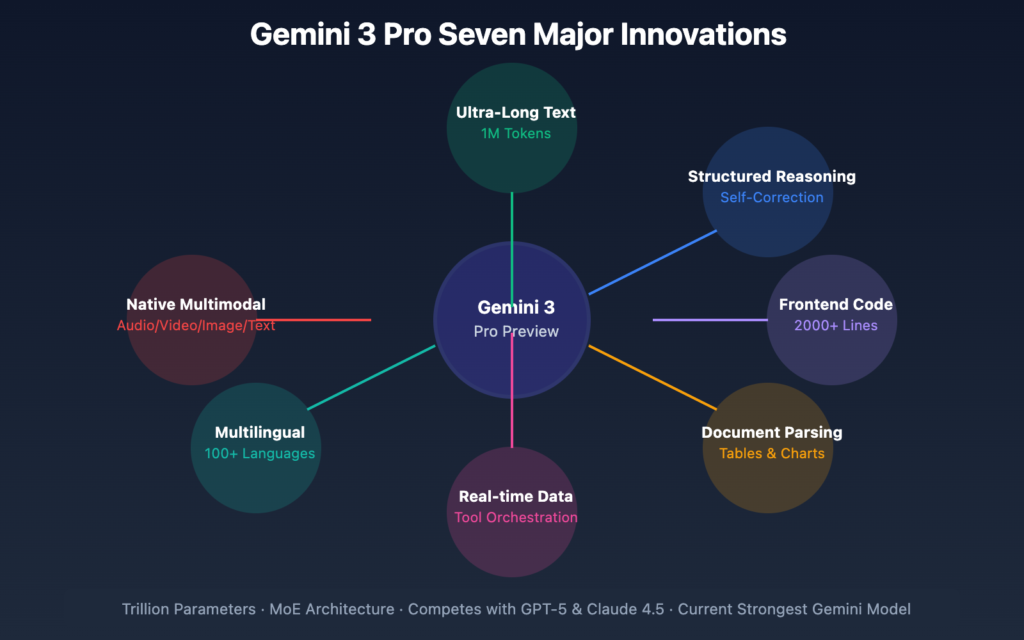
Key Features of Google’s Latest Gemini Generation
Google’s Gemini models are built around several capabilities that make them attractive for modern AI applications.
1. Multimodal AI
Multimodal understanding is one of Gemini’s major strengths. Instead of working only with written prompts, compatible Gemini models can process multiple information formats.
This can be useful for tasks such as:
- Analyzing images and screenshots
- Understanding documents
- Summarizing lengthy material
- Working with audio or video
- Extracting information from visual content
- Generating and reviewing code
For companies handling different types of data, multimodal AI can simplify workflows by reducing the need for separate tools.
2. Advanced Reasoning
Modern AI applications increasingly require more than simple question answering. Developers need models capable of following multiple instructions, analyzing information, solving problems, and maintaining context throughout longer workflows.
Gemini models are designed to support increasingly sophisticated reasoning tasks. This makes them useful for research assistance, programming, planning, data analysis, and AI-agent applications.
However, reasoning performance can differ substantially between Gemini variants, so users should select a model based on the complexity of their specific workload.
3. Coding and Software Development
AI-assisted programming has become one of the most important applications of generative AI.
Gemini can assist developers with tasks such as:
- Writing new code
- Explaining existing code
- Finding bugs
- Refactoring applications
- Generating tests
- Creating documentation
- Understanding large codebases
- Building application components
For development teams, these capabilities can reduce repetitive work and help engineers move from an idea to a working prototype more quickly.
4. Large Context Capabilities
Context length is another important factor when evaluating modern AI systems.
A larger context window allows a model to process more information within a single interaction. This can be especially useful for developers working with large documents, long conversations, extensive codebases, or multiple related files.
For example, instead of analyzing a large project in many small pieces, a model with a large context capacity may be able to understand more of the project at once.
The available context limit varies by Gemini model and product, so developers should check the current technical specifications before building a production application.
Gemini New Model for Developers
Developers are among the biggest beneficiaries of improvements in Google’s AI models.
Through Google’s developer ecosystem, Gemini can be integrated into applications using APIs and supported development tools. This allows businesses to build AI-powered features directly into their products.
Common developer applications include AI chatbots, coding assistants, content-generation systems, document-processing tools, recommendation systems, search experiences, and autonomous workflows.
AI Agents
AI agents are becoming an important use case for advanced language models. An agent can use a model to reason about a task, call tools, process information, and continue working through multiple steps.
A fast and capable model can be particularly useful for these workflows because an agent may need to make multiple model calls while completing a single task.
Web Application Development
Developers can also use Gemini to accelerate web development. A natural-language description can be converted into HTML, CSS, JavaScript, React components, or other application code.
The model can also help explain errors, improve existing interfaces, and generate reusable components.
Document Analysis
Businesses often work with large amounts of unstructured information. AI can help extract important details from reports, documents, contracts, presentations, and other files.
A model with strong context and multimodal capabilities can make these workflows more efficient.
Gemini New Model Pricing
Pricing is one of the most important considerations for anyone planning to use an AI model through an API.
AI providers generally calculate API costs based on factors such as input tokens, output tokens, model selection, and additional features. Some models are optimized for high performance, while others are designed to provide lower-cost processing for large-scale applications.
Google has offered different pricing structures across the Gemini family, and these can change as new models and API options are introduced.
For businesses, the cheapest model is not necessarily the best option. A more capable model may complete a task with fewer retries or produce better results, potentially reducing the overall cost of a workflow.
Before deploying the Gemini new model in production, developers should review Google’s current pricing documentation and calculate expected monthly token usage.
Gemini vs Other AI Models
The AI market includes several major model providers, including OpenAI, Anthropic, Google, Meta, and other companies developing proprietary or open-weight systems.
Comparing Gemini with competing models should involve more than a single benchmark.
Important factors include:
| Factor | What to Consider |
|---|---|
| Reasoning | How well does the model handle complex problems? |
| Coding | Can it reliably generate and modify production code? |
| Speed | How quickly does it respond? |
| Context | How much information can it process? |
| Multimodal Support | Can it work with text, images, audio, and video? |
| Pricing | What is the total cost at your expected usage? |
| API | Is integration easy for your development team? |
| Reliability | Does performance remain consistent at scale? |
Gemini can be particularly attractive for organizations already using Google’s cloud and productivity ecosystem. Meanwhile, other AI providers may offer advantages in specific reasoning, coding, agent, or enterprise scenarios.
The best choice ultimately depends on the application’s requirements.
Real-World Use Cases
The Gemini new model can be applied across a wide variety of industries and workflows.
Business Automation
Companies can use AI to automate repetitive tasks such as summarization, email drafting, document classification, information extraction, and customer-service workflows.
Education
Teachers and students can use generative AI for explanations, study assistance, lesson planning, brainstorming, and personalized learning support.
Marketing
Marketing teams can use Gemini for content ideas, campaign planning, research assistance, product descriptions, social media content, and SEO brainstorming.
Customer Support
Businesses can integrate AI into support systems to answer common questions, summarize customer conversations, classify requests, and assist human support agents.
Software Engineering
Development teams can use AI throughout the software lifecycle, from planning and coding to testing, debugging, documentation, and maintenance.
Advantages of the Gemini New Model
There are several reasons developers and organizations may consider Google’s latest Gemini technology.
Multimodal capabilities: The ability to work with different types of information can simplify complex workflows.
Developer support: Gemini can assist with programming, debugging, documentation, and application development.
Scalability: Cloud-based AI infrastructure can support applications ranging from small experiments to large enterprise workloads.
Large-context workflows: Compatible models can process substantial amounts of information, which is valuable for document and code analysis.
Google ecosystem integration: Organizations already using Google’s technology stack may find Gemini particularly convenient to integrate.
Potential Limitations
Despite its capabilities, no AI model is perfect.
Models can occasionally produce incorrect information, misunderstand instructions, generate flawed code, or make reasoning errors. Developers should therefore validate important outputs rather than treating AI-generated responses as automatically accurate.
Pricing and availability can also change as Google introduces new versions. Some capabilities may only be available in particular models, regions, products, or API configurations.
For business-critical applications, testing the model with real-world data is essential before choosing it for production.
How to Choose the Right Gemini Model
Choosing the right model depends on your workload.
If your application requires fast responses and handles a large number of requests, an efficiency-focused model may be appropriate.
For complex reasoning, advanced research, or demanding analytical workloads, a more capable model may provide better results.
For multimodal applications, check whether the model supports the specific inputs your application needs.
Developers should also compare:
- Expected monthly usage
- Input and output token requirements
- Response speed
- Context requirements
- Coding performance
- Multimodal capabilities
- API features
- Security and enterprise requirements
- Total operating cost
Testing several options with the same real-world tasks is often the most reliable way to make a decision.
Frequently Asked Questions
What is the Gemini new model?
The term refers to Google’s latest Gemini AI model generation. Gemini is a family of multimodal AI systems designed for tasks such as reasoning, content generation, coding, document analysis, and more.
Is Gemini good for coding?
Yes. Gemini models can assist with code generation, debugging, refactoring, testing, documentation, and understanding software projects. Performance depends on the specific Gemini variant and the complexity of the task.
Can Gemini analyze images?
Compatible Gemini models support multimodal inputs, allowing them to understand and analyze images alongside text.
Is Gemini free to use?
Google offers Gemini access through different products and developer options. Some consumer features may be available with free access, while advanced capabilities and API usage can involve paid plans or usage-based pricing.
Which is better: Gemini or other AI models?
There is no universal winner. The best model depends on your requirements for reasoning, coding, speed, multimodal capabilities, context, price, and integration.
Is Gemini useful for businesses?
Yes. Businesses can use Gemini for customer support, automation, document processing, software development, marketing, research, and other AI-powered workflows.
Final Verdict
The Gemini new model represents Google’s continued investment in faster, smarter, and more versatile artificial intelligence. Its combination of multimodal capabilities, reasoning, coding assistance, large-context processing, and developer tools makes the Gemini ecosystem relevant for both individuals and organizations.
For developers, the biggest opportunity is not simply using AI as a chatbot but integrating it directly into real workflows. From autonomous agents and software development to document processing and business automation, modern Gemini models can become an important component of AI-powered applications.
However, choosing a model should always be based on actual requirements rather than marketing claims or isolated benchmark results. Compare current specifications, pricing, performance, context limits, and API capabilities before making a production decision.
As Google’s Gemini ecosystem continues to evolve, developers and businesses should expect AI models to become increasingly capable, efficient, multimodal, and integrated into everyday software.